

When existing capacities are suddenly no longer sufficient
Overcapacity is one of the classic exceptional situations in plant operation. Seasonal peaks, unplanned deliveries, technical restrictions or delays in transportation and marketing can lead to more material being produced at short notice than the existing infrastructure can handle. For plant operators, the question then arises as to how these quantities can be handled in accordance with regulations, economically and without additional burdens for operations and the environment.
With ACT.smallthe mobile demonstration and treatment system from ACT, is a flexible solution that can be used specifically for such situations.
Mobile treatment instead of transportation and external disposal
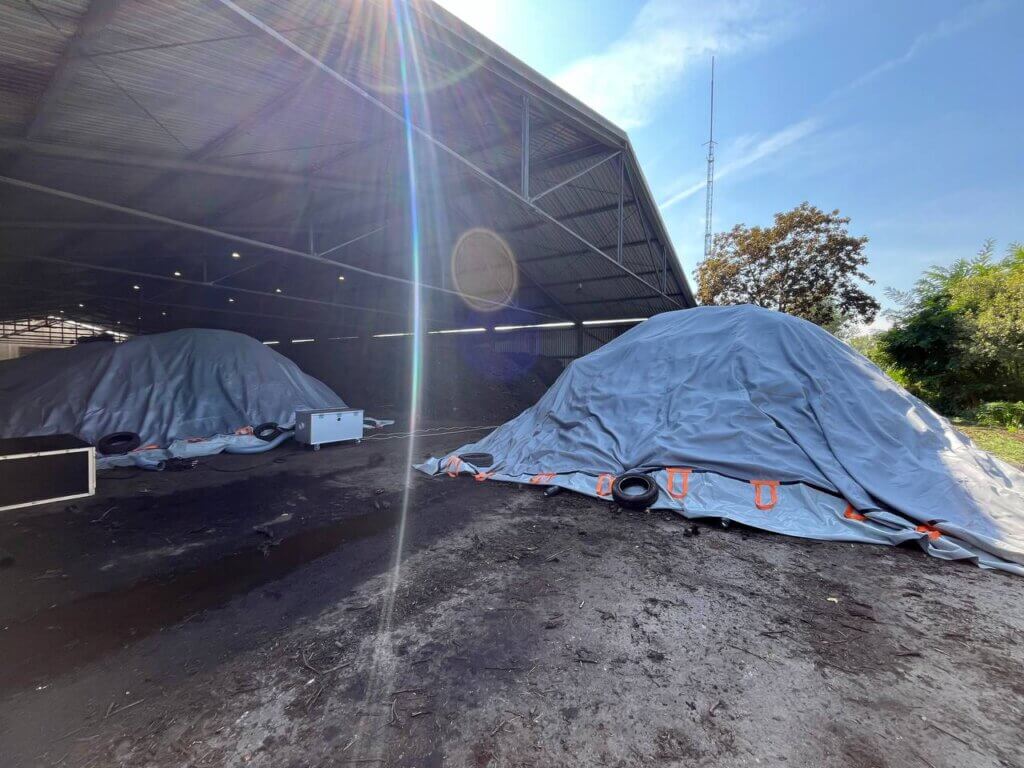
The mobile system is not only suitable for demonstration purposes, but can also be used specifically to treat excess capacity. Thanks to the cover with a semi-permeable membrane, the ACT system can be operated on existing open spaces and is suitable for almost all common input materials.
One unit of the mobile plant has a treatment capacity of around 210 m³, while both units can treat a total of around 420 m³ of material (excluding side walls). Aeration is targeted via pipe systems close to the ground, the rotting process is actively controlled and continuously monitored.
For operators, this means that
excess quantities can be treated directly on site, without additional transportation or cost-intensive external disposal. At the same time, compost of the highest quality is produced that meets the requirements of the Biowaste Ordinance for aerobic sanitizing treatment processes.
Quickly available, ready for use at short notice
A key advantage of ACT.small is the short response time. The system is mobile, easy to transport and usually ready for use within a few days. Depending on availability and location, operation can often begin just two to three days after the request.
Only the following are required on site:
- a wheel loader (ideally with a dumping height of over 3 m)
- one power connection (16 A)
- a suitable open space
This makes the system particularly suitable for operators who need to act quickly without having to initiate lengthy approval or construction processes.

Demonstration of the mobile system
Reducing emissions even with temporary solutions
Emissions are often the focus of the authorities, especially when there is overcapacity. The combination of targeted ventilation and membrane cover effectively retains odors and biological by-products. In previous applications, odor emissions have been significantly reduced (by up to 97 %), meaning that the use of the mobile system is accepted and approved by the authorities in many cases as a temporary solution in open spaces.
A key advantage of this is:
On-site treatment avoids additional emissions from transportation, relocation or interim storage and reduces the risk of incidents during regular operation.
Flexible addition to the existing system concept
ACT.small is not intended as a replacement for existing systems, but as a demonstrative or supplementary solution. Operators can absorb excess capacity in a targeted manner without having to restructure regular operations or permanently maintain additional infrastructure.
At the same time, the mobile plant can be used to gain valuable insights, e.g. to optimize input materials, rotting management or emission behaviour under real operating conditions.
Managing overcapacity quickly and economically
ACT.small provides plant operators with a quickly available, technically proven and economical solution to safely treat excess capacity. Instead of emergency solutions or cost-intensive external disposal, the mobile system enables controlled treatment directly on site: flexible, efficient and approvable.
Whether seasonal peaks, unplanned deliveries or temporary restrictions in the inventory, the mobile system can be flexibly integrated into existing operating processes and offers quick relief without long-term obligations.
Feel free to contact us and we will show you how you can deal with excess capacity quickly, reliably and economically.
Text by Jonas Schmidt