



Check emissions directly at the rental
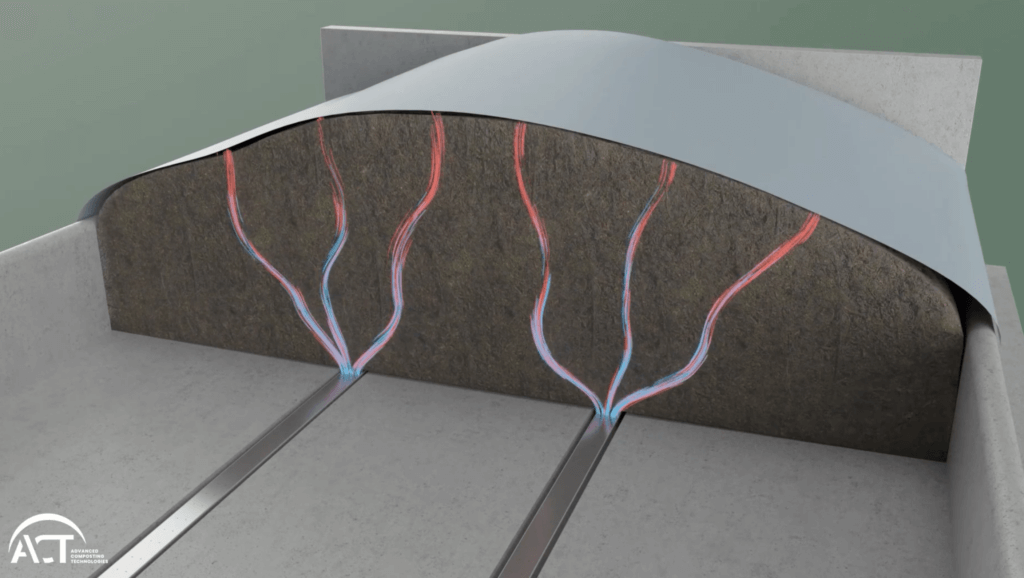
The membrane is the central element of the ACT system. It ensures that emissions are not treated at the hall exit or in downstream units, but where they are generated: directly at the compost heap.
It fulfills two seemingly contradictory requirements at the same time. It is waterproof and robust against the weather, but allows air to escape in a controlled manner. It is precisely this interplay that makes it so effective.
How the membrane works in the process
The membrane is placed over the rent and fixed tightly at the side. Targeted pressurization causes a slight overpressure to build up underneath it, causing it to lift slightly. The warm, moist process air rises from the rotting material and hits the inside of the membrane.

Some of the moisture condenses on contact with the cooler membrane. A thin film of water forms on the inside. This film of water is not a side effect, but a key component in reducing emissions.
Water-soluble substances such as ammonia are bound in this film. Aerosols, dust particles and odor-active accompanying substances are also retained in the humid environment. At the same time, the membrane prevents an uncontrolled flow of air to the outside. The process air can only escape in a damped and uniform manner. This leaves more time for binding and biodegradation in the system.

As soon as the aeration is switched off, the membrane is placed back on the rotting material. The water film with the bound substances is returned to the biological process where it is further degraded. Emissions are therefore not displaced, but treated in a process-integrated manner.
Optimum process control through moisture management
The membrane is completely waterproof against rain and surface water. This protects the windrow from uncontrolled water ingress and prevents nutrients from being washed out. At the same time, the process water in the system remains controllable.
Instead of dilution by rain or uncontrolled leachate formation, the membrane enables stable moisture management. This improves process control, reduces potential discharges and ensures reproducible conditions in the rotting process.
In summary, process control can be significantly improved as a result.
Quality and durability
The membrane used by ACT is manufactured in Europe and meets high quality requirements. It is mechanically stable, weather-resistant and designed for long-term use in composting operations.
With proper handling, the service life is correspondingly long. However, should minor damage occur, it can be easily repaired with repair patches. Openings for sensors or measuring points can be prefabricated without impairing the function of the membrane.
The lateral fastening also ensures that no air can escape uncontrolled at the edge. This means that the effect is not just theoretical, but practically reliable.
Technical background for those interested
The effect of the ACT membrane is not based on a selective gas barrier, but on the targeted influencing of the transport mechanisms between the rotting body and the environment.
Convective flows dominate in open operation. Warm process air rises and transports gaseous substances, aerosols and odor-active components away almost unhindered. The membrane significantly reduces this convective transport. Instead of free flow, a controlled pressure build-up occurs under the cover. The exchange of substances is mainly diffusion-driven and at a greatly reduced discharge rate.
Reduction of convective mass transport
Convection is a volume-driven transport mechanism. If it is slowed down, the emission rate drops considerably, even if individual gases remain fundamentally diffusible. The membrane therefore acts primarily as a flow regulator with defined permeability and not as a rigid gas barrier.
Condensation zone as a temporary liquid phase
The temperature gradient between the warm process air and the cooler inside of the membrane creates a condensation zone. The water film formed represents a temporary liquid phase into which water-soluble substances pass according to their solubility.
Ammonia, for example, dissolves well in the water film and can be present there in protonated form. Odor-active organic components are partially physically absorbed or bound in the liquid phase. In addition, particle-bound emissions are separated on contact with the wet interface.
Return to the biological process
The decisive factor is that these bound substances do not remain permanently on the membrane.
As soon as the aeration is reduced or switched off, the overpressure under the membrane drops. The cover is placed back on the rotting material. The previously formed condensate film runs off or is reabsorbed through contact with the material. The substances dissolved and separated in it are thus returned to the rotting body.
There they are again available for biodegradation. Water-soluble nitrogen compounds can be further converted or bound. Organic odor components are degraded microbially. Particulate substances remain in the material and are integrated into the further rotting process.
The membrane therefore not only reduces emissions to the outside, but also supports an internal material cycle. Pollutants are not discharged, but kept in the process and processed further.
Process stabilization as an additional effect
The dampened oxygen release also stabilizes the aerobic conditions in the rotting body. More uniform oxygen conditions reduce the formation of anaerobic zones and thus the production of climate-relevant gases such as methane or nitrous oxide.
The reduction in emissions thus results from a combined effect of flow regulation, phase transition, interfacial separation and in-process recirculation.
Conclusion
The membrane is the core element of the ACT system. It combines mechanical stability, weather protection and controlled gas exchange with active emission reduction directly at the rental unit.
The attenuated air release, the formation of a condensate film and the in-process recirculation of bound substances significantly reduce odors, water-soluble emissions and particle-bound components. At the same time, the membrane stabilizes the aerobic process control, prevents uncontrolled convection and protects the rotting material from external weather influences.
The result is improved odor reduction, controlled moisture management, lower fugitive emissions and greater process stability.
This makes the membrane a crucial component for stable, low-emission and approvable composting.
If you would like to follow the described process visually, we recommend our YouTube video. The process is clearly illustrated and explained step by step.
Text by Jonas Schmidt